

What are ultra-processed foods, really?
We dug into the research and answered your questions

It’s time for the annual YLE check-in—and I need your help. Please take 7 minutes to fill out this short, anonymous survey so we can shape the future of Your Local Epidemiologist together.
In recent years, ultra-processed food (UPF) has become interchangeable with “junk food” and a convenient scapegoat for many modern health issues. Referred to as “poison” by some, UPFs took center stage in the recent MAHA Commission report, which pointed to them as a key contributor to the chronic disease crisis among children.
But what exactly counts as a UPF? And do they all deserve such a bad reputation? There’s so much curiosity and conversation happening around this topic right now. As with most things in nutrition, the answer is more nuanced than it seems.
What are processed foods?
To understand UPFs, we first must discuss (and appreciate) processing. Humans have processed food for millennia—through cooking, fermenting, milling, and preserving—to make it safer, more palatable, and more stable.
Today, processed foods still serve important purposes: convenience, affordability, shelf life, and accessibility. For example:
Canned beans for an affordable protein source
Microwaveable rice for folks who don’t have a stove
Kid pouches for on-the-go outings
Gluten-free bread for those with celiac disease
Infant formula, an alternative or supplement to breastmilk
Frozen meals for older adults who have difficulty cooking
Calcium-fortified soy milk for those with a dairy allergy
Consistent “safe foods” for people who struggle with food texture (picky eating, Avoidant/Restrictive Food Intake Disorder or ARFID, autism)
Energy bars during natural disaster relief operations
MREs (meals ready to eat) for military training and deployments
In short: processed foods can meet real, practical needs. A strictly whole-foods-only diet isn’t always realistic—or even possible—for everyone. Nearly 1 in 5 U.S. households with children don’t have reliable access to food. In these situations, convenience, cost, and shelf life matter.
What’s an ultra-processed food?
Most foods fall along a processing spectrum, from minimally processed to ultra-processed. The main concerns are about UPFs.
Technical definitions for UPFs vary, but NOVA is the most widely recognized classification system. NOVA defines UPFs as industry-formed products that require a series of processes and additives to preserve shelf-life, prevent bacterial growth and enhance the flavor, color and appearance. NOVA categorizes food into four groups based on the extent and purpose of processing.
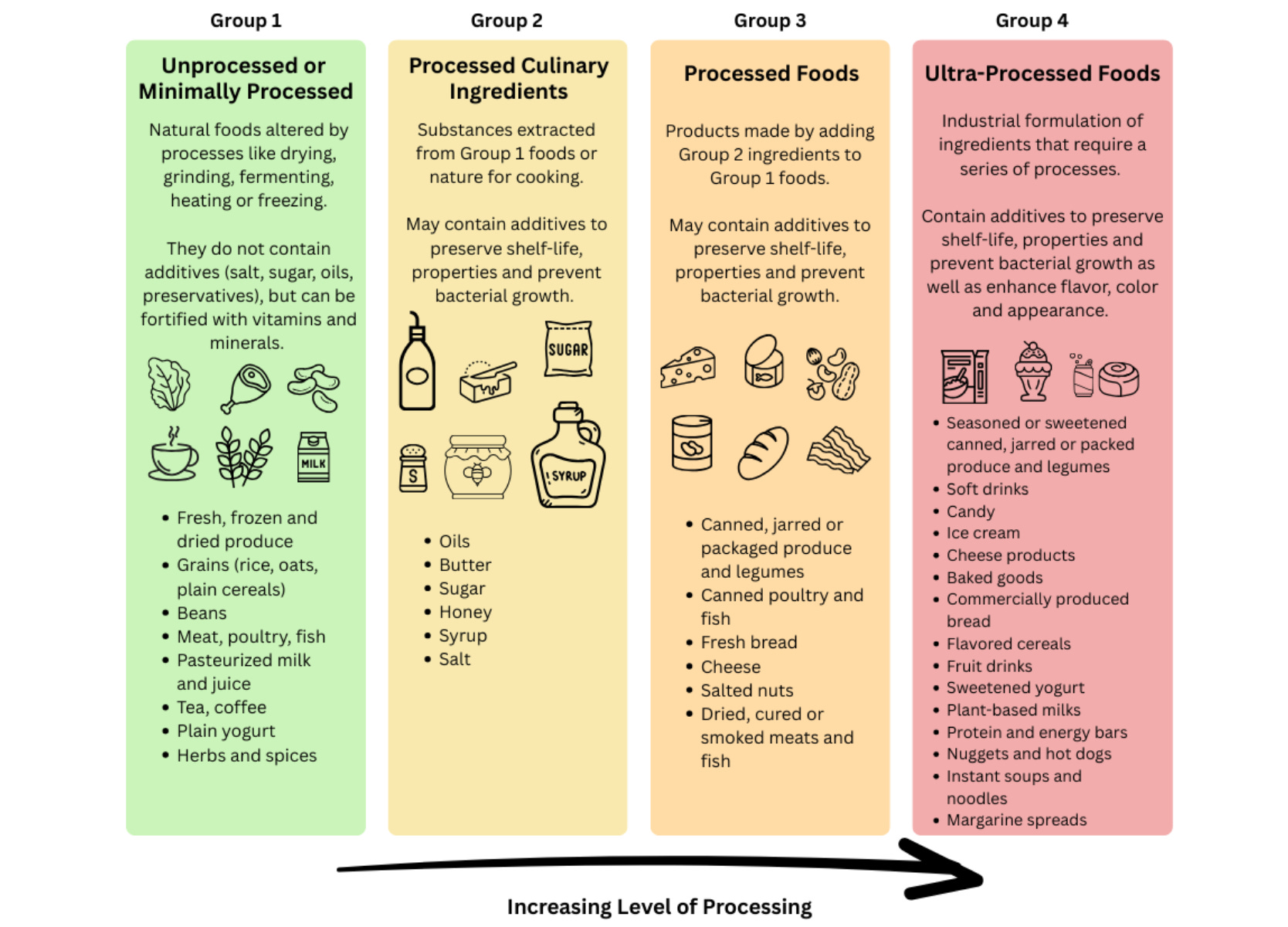
But this system has limits:
Oversimplification: Grouping widely different foods into the same category based on processing rather than nutritional content (e.g., soy milk and soda are both category 4 items)
Imprecise: Foods can be challenging to classify correctly and consistently
Limitations: Categories aren’t always practical because they don’t capture the complexity of individual needs, diversity, accessibility, and cultural relevance.
Still, it’s a helpful starting point.
UPFs and health: What we know
There’s a valid concern about the link between UPFs and poor health outcomes, but we still don’t fully know how and why this happens, which is where the nuance comes in.
Here’s what the science shows so far:
UPF consumption is associated with poor health outcomes. At this point, the evidence is clear that diets high in UPFs are correlated with increased health risks—particularly mortality, cardiometabolic health, and mental health. However, most research is observational (there are very few trials), meaning we don’t know whether the processing leads to poor health or if eating UPFs is simply an indicator of poor diet quality.
UPFs can lead to overeating and weight gain. A landmark 2019 randomized controlled trial (the gold standard for studying causation) found that people ate ~500 more calories per day and gained weight on a UPF diet compared to a nutritionally matched unprocessed diet.
UPFs are everywhere, and they’re cheap. UPFs make up over 70% of our food supply and are significantly cheaper per calorie than unprocessed foods. The food environment is a powerful driver of our eating behavior and health. When UPFs are so widely available and affordable, they can shift towards being the default food choice.
We are eating more UPFs and less minimally processed foods than before. According to a 2025 study, these changes in diet trends are significant. UPFs comprise ~57% of our calories, while minimally processed foods contribute only ~29%.
Most UPFs are not nutritious. Eating more UPFs has been linked to higher consumption of sugar and saturated fat, and lower consumption of protein, fiber, and micronutrients. A 2021 study found 84% of UPFs had a Nutri-Score of “E”—the lowest ranking category.
UPFs can still be a part of a healthy diet. A 2023 study successfully designed a diet with a healthy eating index score of 86/100 where 91% of calories came from UPFs like canned beans, instant oatmeal, ultra-filtered milk, whole wheat bread, and dried fruit. Although not a perfect score, it’s far better than the American average of 58/100. A large 2024 study on heart disease found it’s the type of UPF that really matters—specifically, sugar-sweetened beverages and processed meats were linked to increased risk, whereas bread, cereal, flavored yogurt, and savory snacks were linked to decreased risk.
What we’re still learning
Despite the headlines and the MAHA report, the science is still evolving. Some key questions:
Why are UPFs linked to poor health outcomes? Causal evidence is limited and will require more controlled trials and prospective studies to better understand the mechanisms at play. Additionally, UPF definitions aren’t always consistent, making precision and accuracy in research challenging. This is partly why the recent Dietary Guidelines Advisory Committee did not include recommendations on UPFs for the next 2025 dietary guidelines.
What role do additives play? Preservatives help keep our food safe and reduce waste. Other additives like sweeteners, thickeners, emulsifiers, and colors enhance the taste and appearance of UPFs. Many food additives are backed by strong research on acceptable daily intakes and have been pre-authorized by the FDA. However, there’s growing concern over potential effects on our microbiome (a newer area that warrants more research) and a regulatory loophole around ingredients that are Generally Recognized As Safe or “GRAS.” Specifically, GRAS ingredients don’t require premarket review if their safety is backed by scientific evidence or qualified experts. The issue is that the manufacturer determines the proof of safety and doesn’t require FDA approval (or even notification). While GRAS status can be revoked if scientific evidence shows risk, there has been a call for increased FDA oversight to ensure all additives are reviewed prior to entering the food supply.
Do UPFs have more plastic contaminants? The processing and packaging of UPFs may expose us to more contaminants, like microplastics and phthalates. While we still have a lot to learn in this area, researchers believe higher intake may be harmful to our physical and mental health.
Why do UPFs drive overeating? Contrary to popular belief, UPFs don’t appear to be “addictive” but instead may encourage overeating due to their calorie density and high palatability (thanks in part to the additives).
What about the “food matrix”? Nutrition is more than the sum of its parts. How a food is structured—its physical and chemical matrix—affects how our bodies absorb and metabolize nutrients. Emerging research shows that preserving the food matrix can have unique health benefits that might be lost when the food is ultra-processed, even if the nutritional profile is the same.
Processing is just one piece of the puzzle.
The best diet is nutritious, reasonably balanced, and sustainable for your life. That looks different for everyone. Unprocessed and minimally processed foods are often a safe bet, but processed foods and UPFs can fit into a healthy diet and may even help contribute to one. It’s diet quality in the context of individual needs that matters most.
We can and still should expect better. There is a valid call to improve our food system through policy change. Our food environment promotes UPFs through availability, targeted marketing, and lower prices than healthier options. Policies that make nutritious food more accessible (subsidies, incentives, community programs) and unhealthy food less convenient (taxes, marketing restrictions, regulatory oversight) can shift the food landscape and make healthier eating the easier choice.
Bottom line
UPFs can be bad, but they can also be good. Nutrition and public health are complex, but progress is possible. Aligning science, policy, regulation, and education can harness systemic change so that nutritious eating and good health are not the exception but the norm.
Love, Megan
Thousands of you had questions about practical UPF tips. Here are the top three:
1. What are the top five things to remember/try to avoid around UPFs and health?
As a mom of 4 under 5, both convenience and nutrition are important to me. Here are the things I consider:
Read the label. Specifically, opt for foods that are lower in (<5-10% DV) *added* sugar, sodium and saturated fat, and higher in (>10% DV) fiber, potassium, calcium and vitamin D—the 4 nutrients most Americans don’t get enough of.
Limit sugary drinks and processed meats. These categories have the strongest links to poor health.
Have a critical eye for marketing. The FDA recently updated its authorized use of the term “healthy”—it’s a pretty safe bet for a good choice. Other marketing may not always be a good indicator (e.g., “natural,” “organic,” “pediatrician-approved”).
The ingredient list is helpful, but not all-encompassing. Some unfamiliar-sounding ingredients may be vitamins (e.g., “riboflavin” is vitamin B2, “ascorbic acid” is vitamin C, and “tocopherol” is vitamin E). Additives are regulated and must be safe at ADIs. While there’s a valid criticism of the GRAS process and more research to be done studying effects on the microbiome, most concerns about additives are based on studies with unrealistically high doses or on rodents. Unbiased Science has a more detailed article on this topic.
Be intentional. Aiming for a diet that’s mostly unprocessed or minimally processed is a great goal, but we’re also human, and convenience is sometimes necessary. Being intentional about when UPFs are necessary (travel, outings, special treats, etc.) and how feasible less-processed alternatives would be (time, energy, availability, etc.) can be a useful way to self-evaluate when UPFs are needed versus when they’re convenient (or just a habit).
2. Are any UPFs actually good?
Yes, research shows ultra-processed versions of the five food groups (fruits, vegetables, protein, grains and dairy) can still support a healthy diet—think things like canned fruit, vegetables, fish and legumes, liquid eggs, seasoned chicken, whole wheat bread, instant rice, flavored yogurt, and fortified soy milk. For the most part, these resemble their original or minimally processed food form, but have additional additives for preservation, appearance, and taste (taking them from Group 3 “processed” to Group 4 “UPFs”).
However, this really depends on overall diet and individual needs (health, budget, time, culture). With that in mind, I’ll share a few UPFs I include in my house and a few UPFs I try to limit (purely as an example of unique needs and personal preferences).
I include UPFs like:
Whole wheat bread and tortillas for sandwiches, wraps, and quesadillas.
Ready-to-eat frozen chicken and microwaveable rice for speedy cooking on hectic nights.
Vanilla yogurt because it helps my kids eat probiotics and is a convenient carrier for berries and seeds.
Zero-sugar cranberry juice because I get bored with water.
Mini marshmallows because my toddler is potty training and the positive reinforcement helps.
I try to limit UPFs like:
Sugar-sweetened beverages—to encourage healthy drinking habits for my kids while their taste preferences are still developing.
Hot dogs and processed meat—they taste better at baseball games and fairs anyways.
Ice cream—a family favorite treat, but saved for memorable outings at local parlors.
Kid-focused snacks/products—I don’t love the targeted marketing and they’re often overpriced and not very nutritious. (They also often come individually wrapped and I’m trying to cut back on plastic packaging).
3. Plant-based alternatives are often UPFs. How can they fit in?
Plant-based alternatives can be a nutritious and convenient substitute for folks limiting or avoiding animal-based foods. But products can vary significantly, and “plant-based” or “vegan” doesn’t always mean healthier or more nutritious. Below are a few considerations:
Aim for recognizable plant-based replacements like bean burgers, lentil chili, tempeh bacon or tofu nuggets rather than protein isolate/concentrate options. The more processed versions tend to be higher in additives, saturated fat, and sodium.
Alternatives are not always nutritionally equivalent. Veggie burgers may not always be a good source of protein (depends on their ingredients). Almond and oat milk are lower in protein and typically higher in additives than dairy milk. (Fortified soy is actually the only recommended dairy alternative based on its nutritional profile.) This doesn’t necessarily mean these alternatives are “bad” or can’t support a healthy diet, it just means they shouldn’t be treated as “swaps” nutrition-wise.
“Plant-based” or “vegan” sweets, treats, and snacks are still sweets, treats, and snacks. When in doubt, look at the nutrition label and try to limit products higher in added sugar, sodium, and saturated fat.
Megan Maisano, MS, RDN, is a Registered Dietitian Nutritionist. She holds a BS in psychology from the United States Military Academy at West Point and an MS in nutrition communications and behavior change from the Friedman School of Nutrition at Tufts University. During the day, Megan works at National Dairy Council, a non-profit dairy nutrition research and education organization. (She does not write about the dairy industry for YLE.) Megan is a lifelong learner of all things food, health, and well-being and believes “wellness” is deeply personal and should help us feel nourished and empowered, never restricted or discouraged.
 | A guest post by
|
This is excellent! You’ve outlined critical information in a nuanced way. (I’m one of those people who needs to default to almond or soy milk because I’m severely lactose intolerant, but it’s poured over low-sugar, low-fat granola, chia seeds and loads of berries, which I think redeems it.)
One of the issues that keeps surfacing for me is the potential role that poverty plays in this situation. UPF’s are cheaper. They are more available. They are more satisfying and familiar to many palates. We help support a family in the Appalachian Mountains - in part, by shipping food monthly. (They don’t have easy access to grocery stores.) While less processed options are available, what they request most are ultra processed options. This food is familiar and satisfying to them. As much as I’d love to change this, a gift has no strings attached. I’ll send what they want because I understand that multigenerational poverty is beyond stressful, and I want them to have what they desire. I wish we, as a nation, were willing to take on the impact poverty has on nutrition. The health consequences are dire, and cost us all dearly.
Thank you for this nuanced, detailed article. When people categorically decry all processed food, they are doing so from a position of privilege and ignorance. While I personally may have the economic means to prepare and consume fresh produce and minimally or unprocessed foods at this stage of my life, that was not always the case, and is certainly not the case for the majority of people in this country. Thanks to structural racism and decades of economic suppression in both urban and (ironically) rural areas, much of our population has little access to unprocessed food and very little bandwidth to prepare it. You make an important point about the distinction between healthy-enough processed foods and problematic, highly palatable, high-calorie, low-nutrition foods, especially marketed towards kids. This kind of information is essential to disseminate to the wellness crowd who have an emotional attachment to their dietary choices—which is not necessarily a bad thing, until emotional eclipses rational understanding. Public health policy needs to be for all the people, not just the privileged.