

Ending clock changes. But which direction should we reset the clock?
The science says Congress is getting it wrong


Congress has gotten as far as it ever has in ending twice-a-year clock changes. The House passed the Sunshine Protection Act, which would make daylight saving time (DST) permanent. It now heads to the Senate. If that passes, your mornings will stay darker for longer. But if it doesn’t go through, another bill is coming right behind it that would stabilize clock time in the opposite direction, enacting permanent standard time.
Ending the clock switch is extremely popular, and science agrees stopping this madness is what’s best for our health. But nearly every major sleep-medicine and circadian-biology organization recommends permanent standard time, not permanent daylight saving time (DST), which the House just approved.
The science about why the direction of the clock switch matters starts with your body.
You run on light, not the wall clock
Humans, like nearly every living organism, have an internal biological clock. Deep in the brain, a tiny cluster of cells called the suprachiasmatic nucleus (SCN) controls these circadian rhythms. Unlike the clock on your wall, it keeps time using light.
Every morning, light hits your eyes and signals to the SCN that a new day has begun. Morning sunlight is the single strongest signal for regulating when you feel alert and is far more powerful than indoor light.
Darkness at night also has an important job. As evening falls, your brain begins releasing melatonin—the hormone that signals the beginning of the night—but melatonin is released only if the environment is dim. Bright light at night suppresses melatonin, which can delay sleep and push your wake time later the next day.
Even small shifts in clock time can set up chronic misalignment within your brain. Sustained across millions of people, this can have measurable health consequences for Americans.
Is changing clocks harmful to health?
Yes, and the evidence is very consistent, particularly after we spring forward, but fortunately the impact is transient.
When we spring forward, we lose critical morning light. On average, people lose roughly 40 minutes of sleep that first night. The week that follows brings about 6% more fatal car crashes and nearly 6% more workplace injuries, concentrated in the dark morning hours and mostly gone after a week as people readjust. This may be a small percentage, but summed across 330 million Americans, harm can add up.
The fall transition doesn’t seem to be as harmful to our health and safety: evening crashes rise, but morning crashes drop, and the week nets out flat. “Falling back” is also easier on the body: because our internal clock runs slightly longer than 24 hours, shifting later (what we do in fall) comes more naturally than shifting earlier (what we do in spring)—the same reason flying west is easier than flying east.
If we stop changing the clocks, what is healthier: standard time or DST?
With permanent DST, more than 200 million Americans would receive morning light an hour later by the clock, with winter sunrises after 8:15 a.m. in cities including New York, Chicago, Philadelphia, Washington, D.C., Denver, San Francisco, and Tampa.
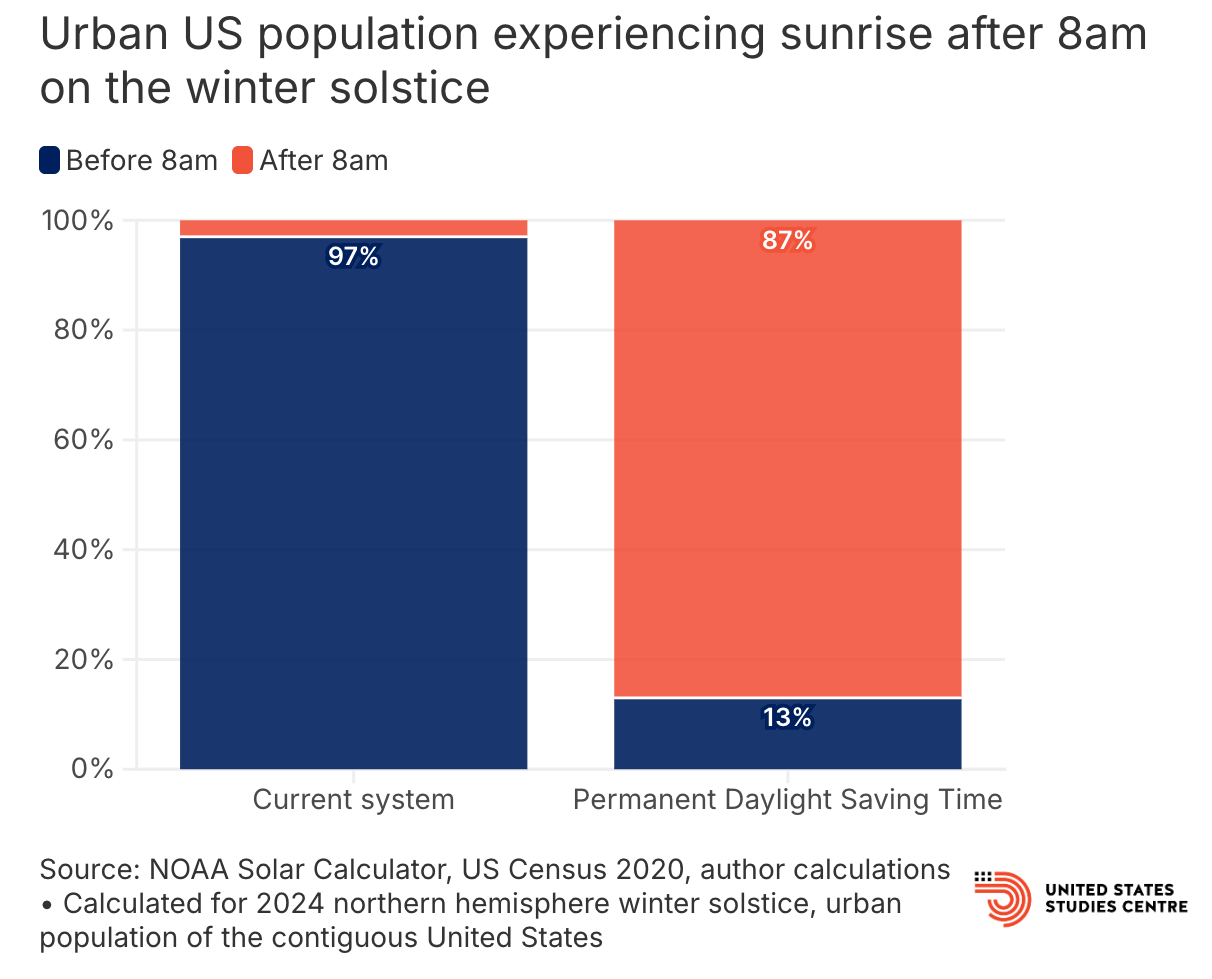
We can’t run the cleanest experiment here. But permanent DST is essentially a milder, permanent version of the circadian strain that makes shift work unhealthy. Shift work is one of the most heavily studied health exposures we have, and it’s repeatedly tied to negative metabolic, cardiovascular, and even cancer risk. The catch is dose: an hour is gentle compared to working overnight, so we know the direction of the harm better than its size.
Circadian biology, laboratory research, epidemiologic studies, and natural experiments indicate that permanent standard time is more closely aligned with human biology:
Circadian biology and laboratory research: Many studies link circadian misalignment to cardiometabolic risk. In a healthy-volunteer study, deliberately shifting people’s body clocks worsened blood sugar levels and raised blood pressure, though the experiment induced far greater misalignment than one hour.
Epidemiologic studies: Across populations, greater circadian misalignment is associated with higher obesity risk. On the western edge of a time zone—where sunrise and sunset both fall later by the clock but work and school schedules stay fixed—people sleep about 19 minutes less a night. The same populations show associations with several adverse health outcomes, including metabolic disease and some cancers, though these observational findings should be read cautiously.
Natural experiment (1974): Congress made DST permanent in January 1974 and repealed it within ten months after parents reported concerns about children walking to school in the dark. Public support fell from 79% to 42% in the first two months. No one systematically tracked health outcomes—it was judged unpopular based on public opinion and energy use alone.
But, as we know, policy is not always determined based on health or science. Supporters of permanent DST point to upsides of lighter evenings, including more after-work daylight for recreation and businesses, which is also important.
You might ask: if the switching is the problem, isn’t any permanent clock better than none? Not necessarily. Under today’s system, at least we’re on standard time all winter, when that light matters most.
What’s next and what it means for you
There is congressional momentum we haven’t seen since the 1970s. The House passed the Sunshine Protection Act, 308 to 117. If it becomes law, the bill would end the twice-a-year clock changes that impact 48 U.S. states and make daylight saving time (DST) permanent. It now heads to the Senate, but following closely on its heels is another bill that would stop semiannual clock switching by repealing daylight saving time and enacting permanent standard time (H.R.9638 - Sunshine for Our Kids Act of 2026).
What this means for you:
Lawmakers are now weighing two different approaches: permanent daylight saving time and permanent standard time. There is still time for public input before Congress makes a final decision. Contact your representatives to share your perspective.
The physiology points to things you can use today: get outside into daylight early, keep your evenings dimmer, and hold a steady sleep schedule.
Prioritize morning light. Get outside in the morning, especially when clocks change, or you change time zones. Sunlight is the strongest signal to reset and stabilize your circadian clock.
Go easy on evening screens (all the time, regardless of time changes). Extra evening light delays melatonin. Screens make it worse, and if you must use screens, also utilize the evening light functions that can mitigate the effects of light at night.
Bottom line
The evidence that changing the clocks twice a year causes short-lived harm is strong, which is why there is broad agreement that the semiannual seasonal switch should end. And Congress has made an important move towards this goal, but in the wrong direction.
Sleep well,
KW and KS
Dr. Katrine Wallace is an epidemiologist and an Assistant Professor of Epidemiology and Biostatistics at the University of Illinois Chicago, School of Public Health, and a scientific communicator. Dr. Katie Sharkey is the Medical Director of the Sleep Medicine Service Line, the Director of the Center for Sleep and Circadian Rhythms Research, and a Professor in the Department of Psychiatry and Behavioral Medicine and Internal Medicine at the Winston-Salem Campus of Wake Forest University School of Medicine in North Carolina.
Your Local Epidemiologist (YLE) comprises a team of experts, ranging from physicians to immunologists to epidemiologists to nutritionists, working together with one goal: to “translate” ever-evolving public health science so that people are well-equipped to make evidence-based decisions. The YLE suite of newsletters reaches over 475,000 people across more than 132 countries. This newsletter is free to everyone, thanks to the generous support of fellow YLE community members. To support the effort, subscribe or upgrade below:
|
 | A guest post by
|
I'm wondering why there is so much more debate on what time the clock says compared to what time school and work and other activities should start and end...
This is one of the few instances in which studies on Americans are less relevant to my community (despite being in the USA). It's pretty hard to believe that 4 pm sunsets in winter are the best for our collective health, but it's what we deal with now (and we'll be stuck with if standard time becomes permanent). I respect that people further south have issues due to shifts in daylight, but it all seems so minor compared to the shifts we see up north. It is interesting to note that British Columbia is on permanent DST, and they experience even more extreme shifts in sunlight.