

Something deeper than hantavirus

Two weeks ago, my phone started lighting up before I’d had my coffee. Journalists, researchers, and neighborhood moms asking the same thing: Should we be worried about this hantavirus thing?
First, I thought this would be an interesting, unique outbreak to “translate” to the public. But over time, public curiosity metastasized into a massive ball of anxiety in the headlines, online, and in some person-to-person conversations.
Right now, the outbreak remains contained, and 41 people are being actively monitored in the U.S. Risk remains low for a number of reasons previously covered. We will continue to follow it.
But when we pause from the numbers, transmission questions, and quarantine, and look up, the response to this outbreak is revealing a lot. Yes, how scary this virus is (it belongs in a thriller novel), and yes, the limits of our scientific knowledge. But also something far deeper.
What we are seeing is the collision of five factors that highlight not only how far we’ve come, but also how deep this country’s wounds still run, and how much work lies ahead.
1. Absent leadership.
Leadership at the federal level is nowhere to be found. Communication has been abysmal, much like it was at the beginning of the Covid-19 pandemic. After a week of silence, an alert was finally sent to physicians and a press conference was held.
But checking these boxes isn’t enough and has led to far too much deflection. For example, there are no numbers on the website, so no one actually knows who is being monitored, where, and how. This leaves massive information voids for falsehoods and rumors to fill.
But also, people don’t just need data or facts; they need steady navigators, grounded in empathy and knowledge, to wade through the oversaturated information landscape.
In crisis communication, a well-known formula is: outrage x hazard. So even if the hazard is low, if concern is great, you’d better be speaking with clarity, acknowledging uncertainty, listening to the questions, concerns, and confusion, and bringing people along for the ride.
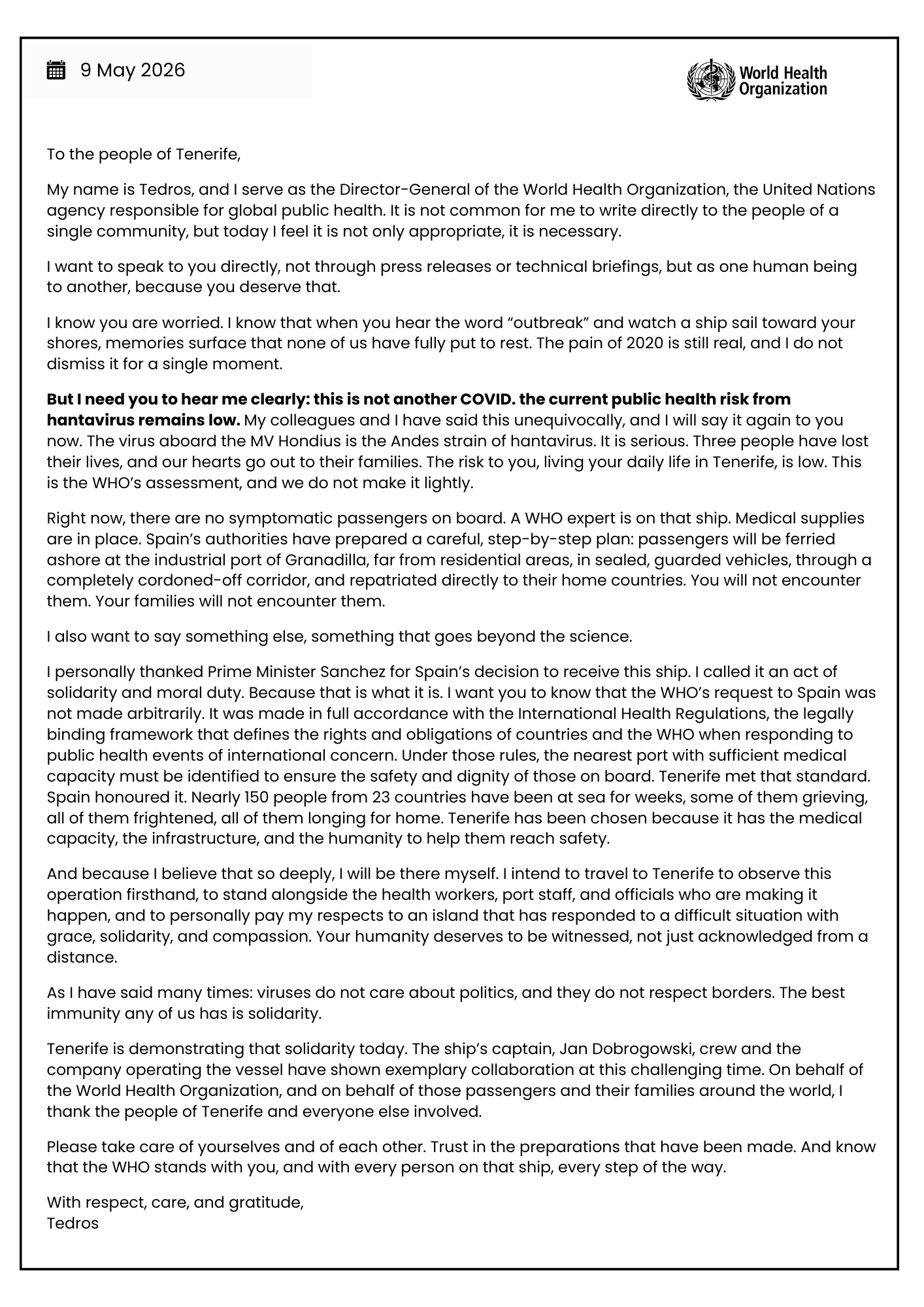
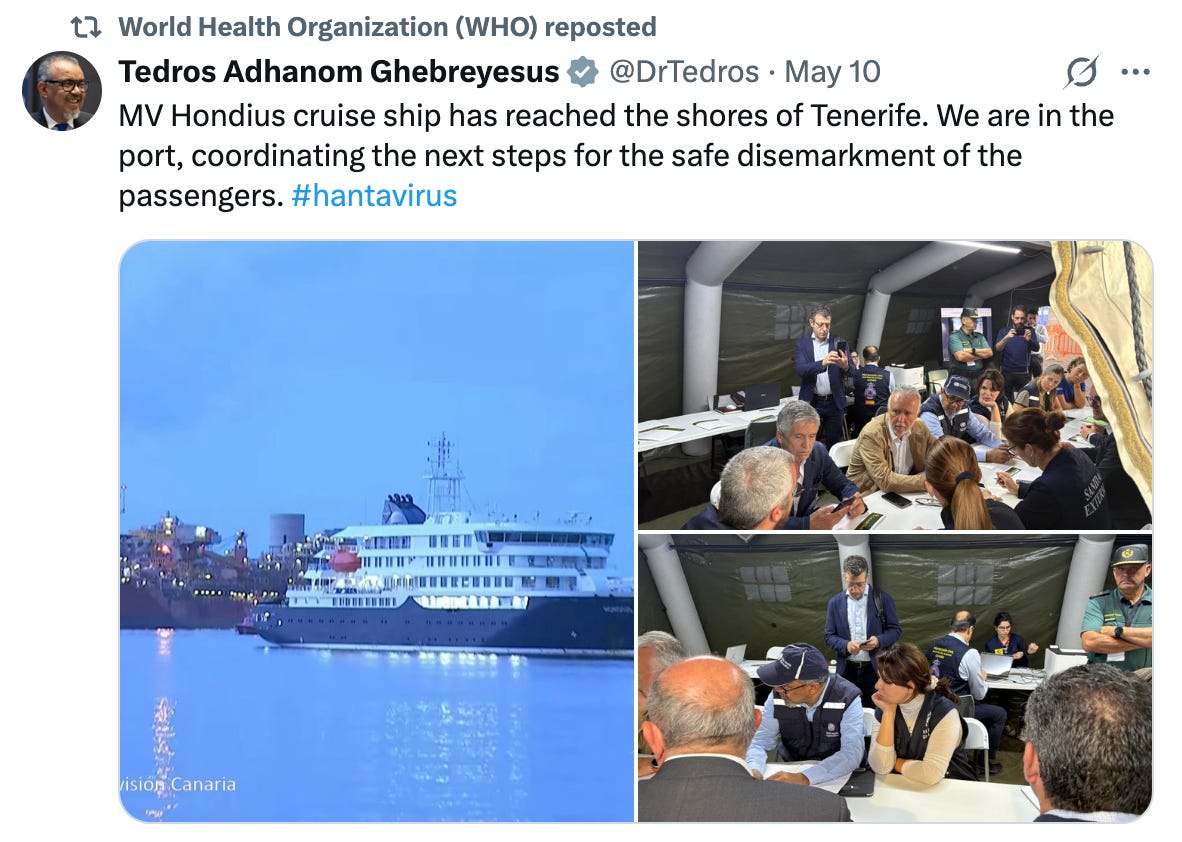
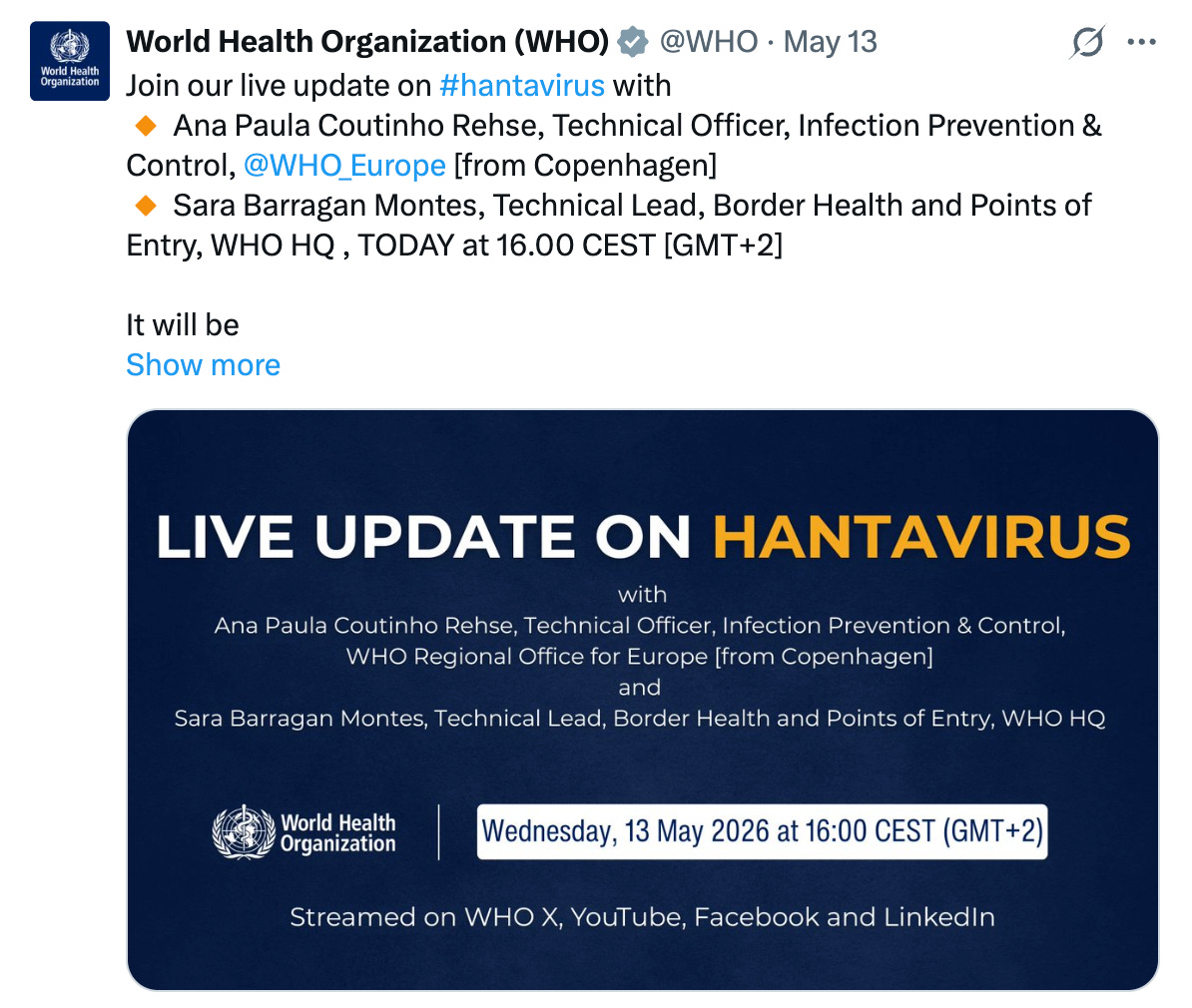
What could this look like? Look no further than the WHO. The WHO director-general traveled to Tenerife in person to speak with residents who were terrified that a boat carrying a highly contagious disease was docking. He led with emotion, grounded in the understanding that 2020 was resurfacing for people, and focused on compassion and solidarity, elevating what one of the passengers said: “We’re not headlines, we are human beings.” In the meantime, they’ve hosted almost numerous live briefings on top of their daily updates on social media accounts and humanized the process with pictures. They aren’t just telling; they are showing.
2. The positive and negative aspects of Covid-19.
The hantavirus response is evidence that the learnings of Covid-19 stuck.
The pandemic became an involuntary crash course in epidemiology for the entire country. Epi 101, taught in real time to everyone at once:
What transmission means.
What incubation periods and case fatality rates actually tell us.
The difference between droplet and airborne spread.
What an R0 is.
What it means when scientists say they’re still learning.
And what, as individuals, we can actually do to feel in control.
During this time, public health was no longer invisible, which is beautiful because, after all, public health belongs to the public.
People now bring a depth of curiosity and literacy that simply wasn’t widespread even in 2018. If Covid-19 was Epi 101, this is Epi 201: taking what we learned from one pandemic and applying it to an entirely different disease.
The challenge with this is that we are changing lanes and, as Adam Grant said, “You don’t have to stay in your lane. You do need to check your blind spots before changing lanes.” After you’ve learned about one outbreak, you’ve learned about one outbreak. There are lessons the public can take, but it’s also easy to fall into blind spots of overconfidence. This is called the Dunning-Kruger effect.
3. The trauma of Covid-19 has not healed. Not even close.
It’s been six years since 2020, and life has returned to a version of normal. I think many had hoped, prayed, and assumed that the wounds of the Covid-19 pandemic had healed.
But when trauma is swept under the rug, it will eventually show its teeth.
A new outbreak entered the news cycle with a lot of the same themes: cruise ships, quarantine, WHO speaking up, scientists speaking up, headlines, uncertainty, and hard reminders of people saying “it’s fine, don’t panic.” So, internal threat systems went into overdrive. This is what our bodies are designed to do: respond to a new threat based on prior experience. It’s literally our survival mechanism.
As my friend Dr. Celine Gounder said: “The intensity of the reaction [also] tells you everything about the depth of the wound.”
4. Mistrust is pervasive.
This outbreak is showing that few people trust authorities and few trust their fellow Americans to do the right thing, like quarantine responsibly.
We entered the pandemic with a slow erosion of trust in institutions, such as government and the mass media. And it was deserved. Many institutions were built for a different time, and when institutions fail to adapt, people are left behind, and trust erodes.
The pandemic accelerated mistrust on one side. For them, the experience felt like an overreach. A government that moved to control behavior, restrict movement, and mandate compliance, often without consistent logic or transparency.
But then, after the pandemic, the pendulum swung violently in the other direction. What felt like a restoration of sanity to some felt like an abandonment of truth and decency to others.
The tribalism has become so strong that it’s not only eroded trust in the systems that are supposed to keep us safe, but also in each other.
This is not only deeply heartbreaking for society, but also leaves us incredibly vulnerable to threats within and outside of our country.
5. Social media and the hurting media economy are fueling the embers.
An accelerant is the information landscape. Information is spreading like wildfire on social media, adding extraordinary complexity for people earning to understand what to believe, from whom, and when.
Social media algorithms and news headlines are built to play on emotion and engineered to surface rage and fear because rage and fear make us scroll, click and sells ads. This creates a seriously challenging echo chamber all of us can get stuck in, where we think every conversation is like the one we are in.
At YLE, we saw this in real time. Not only do we do social listening on the backend, but we also have a weekly survey to understand things not in the media environment. Usually what we hear from these sources matches; after all, 1 in 2 Americans get their health-related information online. But this week was different: on social media, there was spiraling. In the survey? Only 20% were concerned; 60% were just curious about what was going on.
So where does this lead us?
If you felt something or saw this beneath the surface these past two weeks, you’re not alone. What we are experiencing is a deep collision of massive forces, with all of us stuck in the middle.
As a society, we have serious work to do. We need to reckon honestly with the trauma we never processed. And our leaders and institutions need to stop talking about rebuilding trust and actually do it.
For individuals, I think this means:
Keep learning Epi 201. Lead with curiosity and humility, as many people are taking the course.
Triple-check your sources and be sure to share trusted information. Here are nine ways to spot falsehoods that I wrote about a few years ago.
Give yourself grace—and give it to those trying to communicate in real time, in an arena where the answers aren’t always clear yet.
Put down social media. Have conversations with people outside your bubble. Get involved in your community. This country is deeply wounded, and change and sanity start locally.
Bottom line
Hantavirus may be contained. But the conditions that made these two weeks so destabilizing are not. The real outbreak is one of fractured trust, unhealed trauma, and absent leadership. No one is coming to fix it but us. We all have a role to play.
Love, YLE
Your Local Epidemiologist (YLE) is founded by Dr. Katelyn Jetelina, MPH PhD—an epidemiologist, wife, and mom of two little girls. YLE comprises a team of experts, ranging from physicians to immunologists to epidemiologists to nutritionists, working together with one goal: to “Translate” ever-evolving public health science so that people are well-equipped to make evidence-based decisions. YLE reaches over 425,000 people across more than 132 countries. This newsletter is free to everyone, thanks to the generous support of fellow YLE community members. To support the effort, subscribe or upgrade below:
This grace and sanity is why I love YLE so much. I have not been worried about hantavirus. But I am deeply worried about the lingering trauma from COVID and the erosion of trust between Americans and in American institutions.
This is an amazing analysis and even speaks to a foundational problem we have: the regime in power, fully authoritarian and likely fascist, has as its over-arching goal the breakdown of public trust in any expert and authentically authoritative source of real information. These "enemies" of the regime include the entire scientific community, educational institutions at all levels, religious authorities that disagree with regime pronouncements and even what's left of our once functioning government. The regime's aim is to remove any voice other than that of the "leader". THIS is our number one public health threat. Authoritarians make every aspect of life political and this is no exception. While we marshal our forces to fill the information gap (a critically important effort) we must work relentlessly to win in November.